Last month I sat in a small transport office in Ambattur, on the northern edge of Chennai, waiting for a friend who runs three tempo trucks. Two of them were bought second-hand. The third, delivered in July, was financed through an NBFC he found on his phone. “I didn’t visit a single branch,” he told me, half-proud and half-amazed. “I typed ‘commercial vehicle loan near me’ and the guy called me back in twenty minutes.”
That one sentence sums up where India’s vehicle finance market is heading. And now there’s data to back it up.
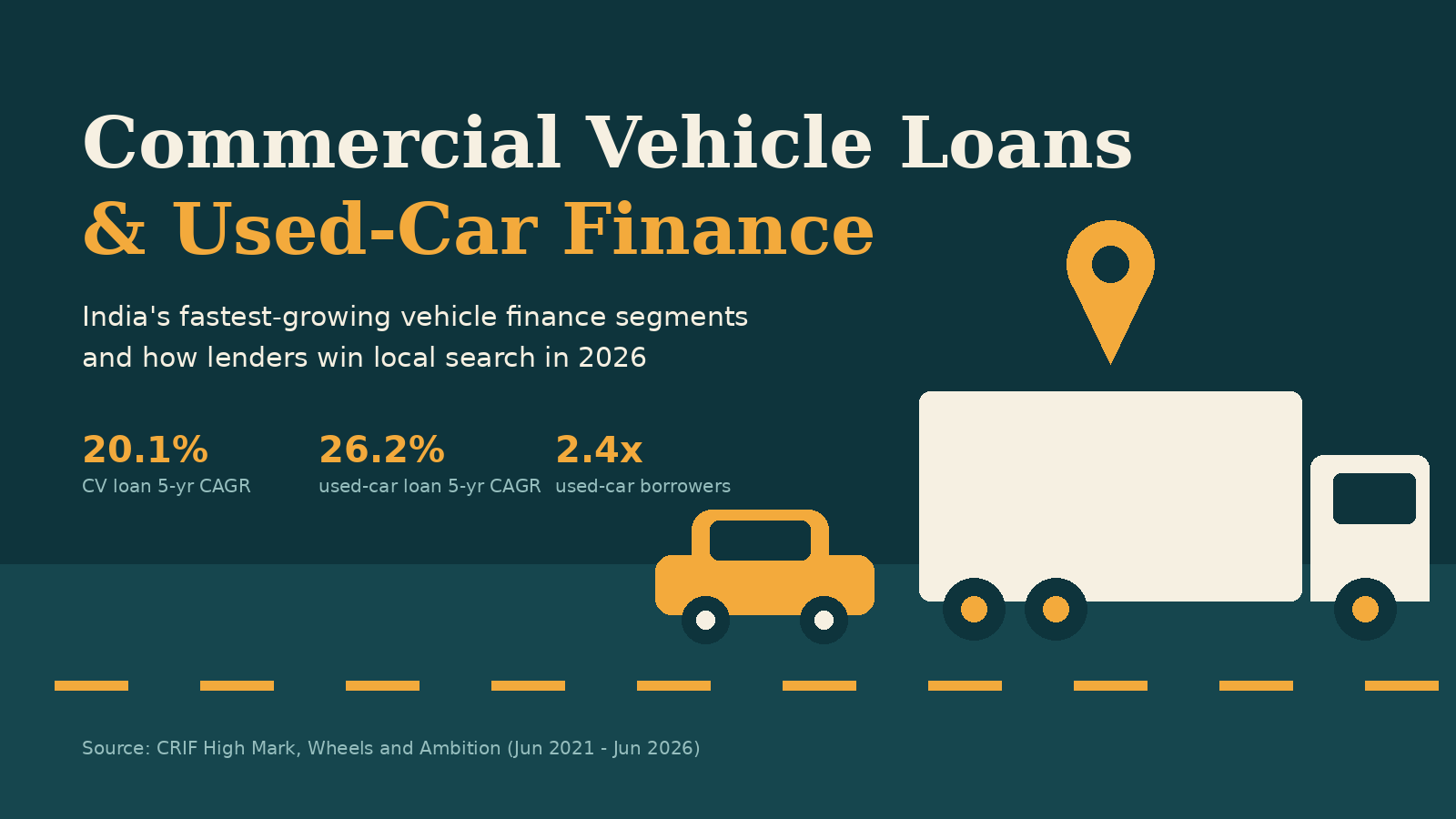
In August 2026, credit bureau CRIF High Mark published a report titled *Wheels and Ambition*, a five-year look at how Indians borrow to buy vehicles. The findings were clear. Between June 2021 and June 2026, used-car loans grew at a compound annual growth rate (CAGR) of 26.2%, the fastest of any vehicle-loan category. Commercial vehicle loans came in second at a 20.1% CAGR, and the report singled out the segment as the market’s clearest growth engine.

A few more numbers worth holding onto:
- The used-car borrower base expanded roughly 2.4 times in five years, and about 75% of new used-car loan originations came from people who had never taken that kind of loan before.
- Overall vehicle-finance originations rose 17.1% year-on-year in the first quarter of FY27.
- In commercial vehicle lending, loans in the ₹5 lakh to ₹10 lakh range went from 22.4% of originations in Q1 FY25 to 30.5% in Q1 FY27, a sign that small operators are buying slightly bigger, newer vehicles.
- Two-wheeler loans remain the largest segment by headcount, with the borrower base rising from around 2.3 crore to 3.6 crore, and about 80% of those borrowers new to credit.
- Put simply, India’s vehicle finance market is no longer one big undifferentiated pool of car loans. It has split into distinct segments with their own borrowers, their own risks and, as we’ll see, their own search behaviour.
Why now? Three forces behind the shift
1. The used-car market finally went formal
Ten years ago, buying a used car in most Indian cities meant a cash deal with a broker, a handshake and a lot of hope. That world hasn’t disappeared, but it’s shrinking. Organised platforms, certified pre-owned programmes from manufacturers and lenders willing to fund a five-year-old hatchback have changed the maths. When you can get a loan against a used car at a reasonable rate, more people are willing to buy one, and more sellers are willing to document the transaction properly.
Business Today’s coverage of the same CRIF report highlighted that Uttar Pradesh recorded the fastest used-car financing growth among major states at a 32.6% five-year CAGR, with Karnataka at 31% and Telangana at 29.7%. Those aren’t just metro numbers; they reflect Tier-2 and Tier-3 towns where a financed used car has become the sensible first car.
2. Logistics demand is real and it’s local
Every quick-commerce order, every e-commerce return, every bag of cement moving from a depot to a construction site rides on a commercial vehicle. India’s freight economy has been expanding steadily, and the vehicles doing the work are increasingly owned by small operators with one to five trucks, not large fleets.
That’s why the commercial vehicle loan has become such an important product. It sits at the intersection of infrastructure, e-commerce and self-employment. The CRIF report also noted a rise in borrowers holding multiple commercial vehicle loans at once, which is exactly what you’d expect when a one-truck owner becomes a three-truck owner.
3. Digital lending removed the friction
Aadhaar-based e-KYC, account aggregator consent, GST-linked income assessment and instant credit bureau pulls mean a lender can assess a small transporter in hours rather than weeks. For borrowers, this shows up as the ability to check commercial vehicle loan eligibility on a phone before ever speaking to anyone.
The hyperlocal search story of 2026
Here’s the part most industry reports skip: what are people actually typing into Google?
Anyone who tracks search demand in the auto finance space will tell you the same thing. Over the last two years, the biggest change hasn’t been *what* people search for. It’s *where* they attach the query. Generic searches like “vehicle loan” have plateaued. Searches that combine a product with a place, a vehicle type or a specific question have taken off.
A few patterns that show up consistently in 2026 search data and in the queries lenders and dealers report hearing:
City-plus-product queries
“Commercial vehicle loan in Coimbatore”, “used car loan Lucknow”, “truck loan Hyderabad”. People want to know who lends in their city, not who lends in India. This mirrors the state-level growth numbers from CRIF: where financing penetration is rising fastest, city-level search volume follows.
Vehicle-specific queries
“Tata Ace loan EMI”, “Bolero pickup finance”, “Ashok Leyland Dost loan interest rate”. The commercial vehicle buyer is often researching the vehicle and the loan in the same session.
Calculator queries
“Commercial vehicle loan EMI calculator” has become one of the most valuable long-tail phrases in the category. It signals a borrower who’s past the “should I” stage and into the “can I afford it” stage. Searches for “used car loan EMI calculator” follow the same logic.
Eligibility and documents
“Commercial vehicle loan eligibility for first-time buyer”, “CV loan without ITR”, “documents required for truck loan”. These queries are most common in smaller cities, where first-time operators are entering the formal credit system.
Rate comparison
“Commercial vehicle loan interest rate 2026”, “lowest CV loan rate NBFC vs bank”. Rate-shopping has become normal behaviour.
Regional-language search.
Voice and vernacular queries in Tamil, Telugu, Hindi and Marathi for “truck loan” and “used car loan” have grown noticeably. Google’s own regional-language push means a driver in Madurai can ask his phone, in Tamil, what a commercial vehicle loan will cost him and get a usable answer.
The lesson for lenders, dealers and content publishers is simple:
If your page doesn’t mention a city, a vehicle type or a specific question, it’s invisible to the 2026 borrower.
Understanding the commercial vehicle loan in 2026
If you’re one of those borrowers, here’s what actually matters.
What is a commercial vehicle loan?
A commercial vehicle loan is a secured loan used to buy vehicles that earn income: trucks, tippers, tankers, pickups, tempos, buses, taxis and increasingly electric three-wheelers and cargo EVs. The vehicle itself is the collateral. Banks, NBFCs and captive finance arms of manufacturers all offer them, and the terms vary widely depending on who you are and what you’re buying.
Loans are available for new and used commercial vehicles. Used CV financing has grown alongside used-car lending for the same reasons: a two-year-old truck with a clean service record is a far cheaper way to enter the transport business than a brand-new one.
Commercial vehicle loan interest rate: what to expect
The commercial vehicle loan interest rate depends on more variables than a home loan or a personal loan. Lenders typically look at:
Vehicle type and age: New light commercial vehicles from mainstream manufacturers attract the lowest rates. Older or heavier vehicles carry higher rates.
Borrower profile: An established fleet operator with GST returns and two years of banking history will get a better rate than a first-time owner-driver.
Loan-to-value ratio: A larger down payment usually earns a lower rate.
Lender type. Banks tend to offer lower rates but stricter eligibility. NBFCs are more flexible on documentation and faster on disbursal but price that flexibility into the rate.
In practice, rates in 2026 span a broad range, from single digits for prime borrowers buying new vehicles at large banks to the mid- or high-teens at NBFCs serving first-time buyers with thin credit files. Always ask for the effective annual rate, not just the flat rate, and ask whether the rate is fixed or floating.
One caution from the CRIF data: commercial vehicle loans showed the highest early-stage delinquency of any vehicle segment, with a portfolio-at-risk (31 to 90 days overdue) of 4.1% in June 2026. That’s not a reason to avoid the product, but it is a reason lenders price carefully and a reason borrowers should be honest with themselves about monthly cash flow.
Commercial vehicle loan eligibility
Commercial vehicle loan eligibility criteria differ by lender, but the common threads are:
Age: usually 21 to 65 at loan maturity.
Business vintage: many lenders prefer at least one to two years in transport or a related business, though first-time buyer schemes exist.
Income proof: ITR, GST returns, bank statements or, for smaller operators, a mix of bank statements and existing contracts or trip records.
Credit score: a score above roughly 700 opens most doors. Lower scores don’t rule you out, but expect higher rates and a bigger down payment.
KYC: Aadhaar, PAN, address proof and, in many cases, a valid commercial driving licence or a fleet permit.
Vehicle documents: proforma invoice for a new vehicle; RC, insurance, valuation and fitness certificate for a used one.
The trend towards digital eligibility checks means you can usually find out within minutes whether you qualify in principle. Use that. There’s no reason to visit five dealers to be told the same thing.
Commercial vehicle loan EMI calculator: use it before you fall in love with a truck
A commercial vehicle loan EMI calculator does one simple thing well: it turns a loan amount, an interest rate and a tenure into a monthly number. Any decent lender’s website has one. What matters is how you use it.
Run it three ways:
1. The plan. Your expected loan, rate and tenure. This is your baseline EMI.
2. The stress test. Add two percentage points to the rate and knock a year off the tenure. If this EMI would sink you in a slow month, the loan is too big.
3. The prepayment scenario. Many operators plan to prepay from strong months. Check what prepayment charges apply and how much interest you’d save.
Then compare the EMI against realistic monthly earnings from the vehicle, after diesel, driver salary, tolls, maintenance and insurance. A rule of thumb many veteran operators use: the EMI should not exceed about a third of the vehicle’s net monthly earnings in an average month.
What this means for different people
If you’re a first-time transport operator:
The market has never been friendlier. Lenders actively want your business, used vehicles are financeable, and the paperwork has shrunk. Take the time to compare at least three offers, and read the prepayment clause.
If you’re buying a used car:
You’re part of the fastest-growing segment in Indian vehicle finance. Insist on a proper valuation and a clean RC transfer, and understand that used-car loan rates are typically a couple of points above new-car rates because the collateral depreciates faster.
If you’re a dealer or lender: the search data is telling you something. Borrowers are searching locally, by vehicle model, and with specific questions about rates, eligibility and EMIs. Content that answers those questions for a specific city and a specific vehicle wins. Generic landing pages don’t.
If you’re an investor or industry watcher:
The CRIF report frames commercial vehicles as macro-driven growth and used cars as a scalable opportunity. Both are correct. But watch the delinquency numbers, because rapid growth in first-time borrowers always tests underwriting quality two or three years later.
The road ahead
Back in that Ambattur office, my friend’s third truck was already booked for a Bengaluru run the next morning. His fourth, he said, would be electric, and he’d already checked the EMI on his phone.
That’s the India that the CRIF numbers describe. Vehicle finance is no longer just about cars for salaried families in metros. It’s about a tempo owner in Ambattur, a used-car buyer in Lucknow, a two-wheeler rider in Warangal who’s borrowing for the first time. The fastest-growing segments are the ones closest to the ground.
If you’re planning a commercial vehicle loan this year, the tools are all there:
An EMI calculator to size the loan, an eligibility check to know where you stand, and enough competition among lenders to make rate comparison worth your time. Use all three. The vehicle will earn its keep; make sure the loan does too.