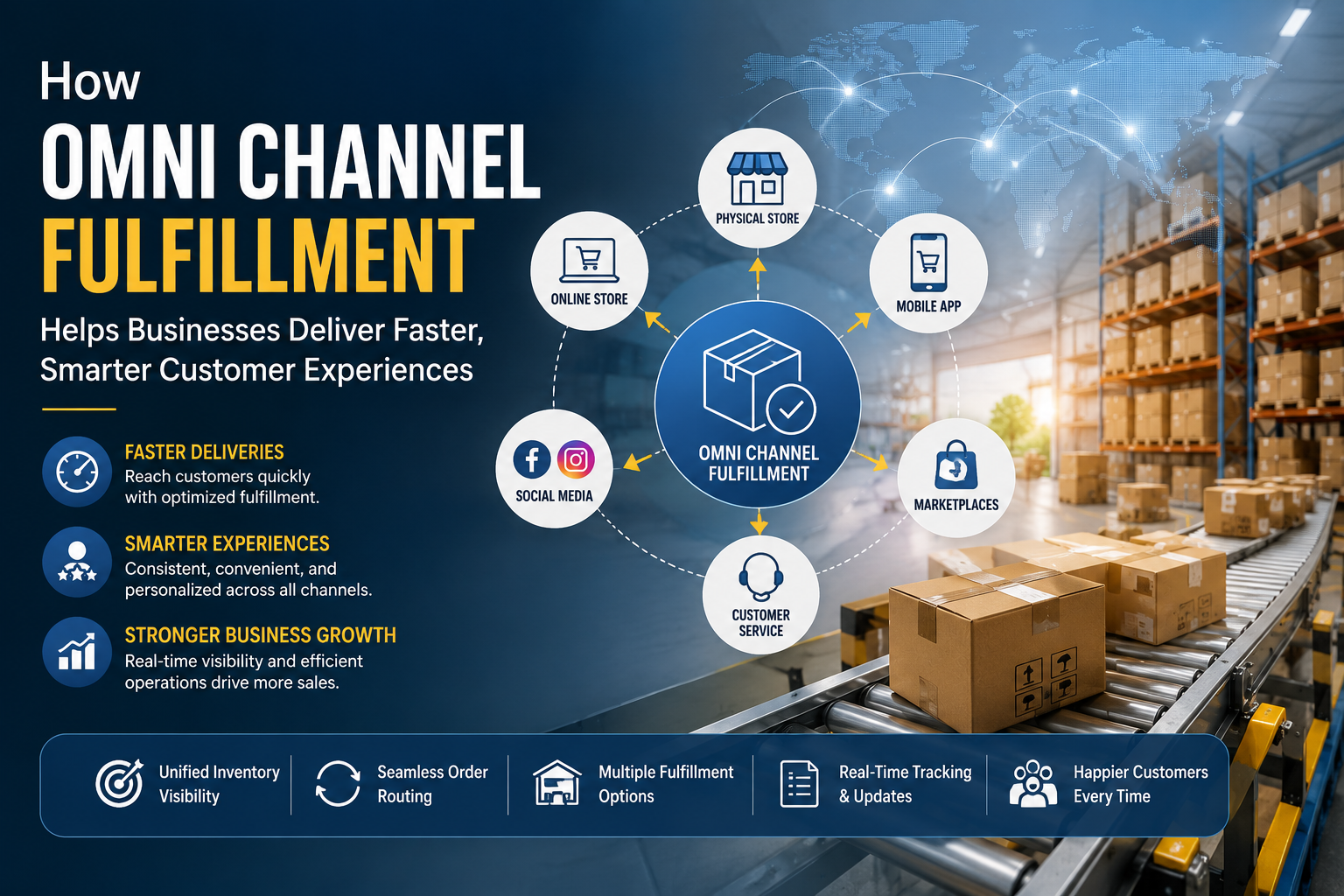
Modern customers expect convenience, speed, accuracy, and flexibility throughout the buying journey. A shopper may discover a product through social media, place an order through an online store, purchase through a marketplace, or visit a physical retail location. Meeting these expectations requires a fulfillment strategy capable of connecting multiple sales channels while maintaining consistent inventory and delivery performance.

Omni channel fulfillment provides a practical solution by connecting inventory, order processing, warehousing, packing, and shipping across different sales channels. Instead of managing each channel independently, businesses can create a coordinated fulfillment network designed to deliver orders efficiently and provide a seamless customer experience.
For growing eCommerce brands, retailers, and businesses with multiple sales channels, this approach can improve operational efficiency while supporting faster and smarter customer experiences.
What Is Omni Channel Fulfillment?
Omni channel fulfillment is a logistics approach that coordinates orders and inventory across multiple selling channels. These channels can include websites, marketplaces, mobile applications, social commerce platforms, physical stores, and business-to-business sales.
A centralized fulfillment strategy gives businesses greater visibility into available inventory and incoming orders. When an order arrives, the fulfillment operation can identify the most suitable inventory location and fulfillment method.
For example, an order placed through an online store could be fulfilled from a strategically located warehouse rather than from a distant facility. This can reduce shipping distances, improve delivery speed, and help control transportation expenses.
1. Creates a Connected Customer Journey
Customers rarely interact with a brand through only one channel. A shopper might research a product online, compare prices through a marketplace, and complete a purchase using a mobile device.
Omni channel fulfillment connects these experiences by supporting consistent order and inventory management across channels. Customers can receive reliable information about product availability, shipping options, order status, and delivery expectations.
A connected fulfillment process reduces friction and helps create a more convenient purchasing experience.
2. Improves Inventory Visibility
Inventory accuracy is essential for successful fulfillment. Overselling products, inaccurate stock counts, and delayed inventory updates can lead to canceled orders and disappointed customers.
An integrated omni channel fulfillment strategy provides better visibility into inventory across warehouses, stores, and other fulfillment locations. Businesses can monitor stock levels more effectively and make informed decisions about replenishment and order allocation.
Improved visibility also helps businesses identify slow-moving products, high-demand items, and potential inventory shortages before operational problems occur.
3. Supports Faster Order Processing
Speed has become an important factor in customer satisfaction. Customers increasingly expect orders to move quickly from checkout to shipment.
Omni channel fulfillment helps streamline order processing by connecting sales channels with fulfillment operations. Automated order routing can direct orders to appropriate facilities while reducing manual intervention.
Faster picking, packing, labeling, and shipping can shorten fulfillment cycles and help businesses meet customer delivery expectations.

4. Enables Strategic Order Routing
Not every order should be fulfilled from the same warehouse. Shipping distance, inventory availability, customer location, and delivery requirements can all influence the best fulfillment location.
A coordinated fulfillment model allows businesses to route orders based on operational priorities. For example, an order can be assigned to a warehouse with sufficient stock and a shorter shipping distance.
Strategic order routing can improve delivery speed while helping businesses manage transportation costs more efficiently.
5. Strengthens Omni Channel Third Party Logistics
Businesses that operate across several channels may require specialized logistics expertise. Omni channel third party logistics can provide the infrastructure and operational support needed to coordinate inventory, orders, warehousing, packaging, and transportation.
A 3PL partner can connect fulfillment operations with eCommerce platforms, marketplaces, inventory systems, and shipping carriers. This creates a more unified logistics environment without requiring a business to build every capability internally.
For companies experiencing rapid growth, outsourcing selected fulfillment activities can also free internal teams to focus on product development, marketing, sales, and customer engagement.
6. Provides Scalable Fulfillment Operations
Growth can create significant pressure on fulfillment operations. Higher order volumes require more warehouse capacity, labor, technology, packaging resources, and shipping coordination.
An omnichannel 3PL company can provide scalable infrastructure designed to accommodate changing fulfillment requirements. During seasonal peaks or promotional campaigns, additional operational capacity can help businesses process higher order volumes without sacrificing accuracy.
Scalability also allows businesses to expand into additional sales channels without completely redesigning the fulfillment operation.
7. Reduces Fulfillment Errors
Manual data entry and disconnected systems can increase the risk of fulfillment mistakes. Incorrect products, quantities, shipping addresses, or labels can result in returns, additional shipping expenses, and customer dissatisfaction.
Integrated fulfillment systems can automate important parts of the order workflow. Accurate order information can move from the sales channel to warehouse operations, Copilot agents for SharePoint helping fulfillment teams process orders with fewer manual steps.
Better accuracy contributes to lower operational costs and stronger customer confidence.
8. Improves Delivery Transparency
Customers want to know where an order is and when delivery is expected. Limited visibility can create unnecessary customer service inquiries and uncertainty.
Omni channel fulfillment can connect order processing with tracking information, giving customers greater visibility throughout the delivery journey. Automated notifications can communicate important updates, including order confirmation, shipment status, and delivery progress.
Greater transparency creates a more professional customer experience and can strengthen brand trust.
9. Supports Better Returns Management
Returns are an important part of modern eCommerce. A complicated return process can negatively affect customer satisfaction even when the original order was delivered successfully.
A coordinated fulfillment strategy can help businesses organize return authorization, product receiving, inspection, restocking, and replacement processes. Centralized information can make returns easier to track and manage across multiple sales channels.
Efficient reverse logistics can turn a potentially frustrating experience into an opportunity to demonstrate strong customer service.
10. Helps Businesses Make Smarter Decisions
Data is one of the most valuable advantages of connected fulfillment operations. Businesses can analyze order volumes, inventory movement, fulfillment times, shipping patterns, and channel performance.
These insights can support smarter decisions about inventory placement, warehouse capacity, shipping methods, product availability, and sales-channel strategy.
Instead of relying on disconnected reports, businesses can use fulfillment data to identify operational opportunities and respond more effectively to changing customer demand.
Momentum Shipping Company and Modern Fulfillment
For businesses looking to strengthen fulfillment performance, working with an experienced logistics provider can simplify the transition toward a more connected operation. Momentum Shipping Company provides tailored 3PL and logistics solutions designed to support efficient warehousing, fulfillment, inventory management, packaging, and shipping.
A technology-enabled fulfillment strategy can help businesses connect multiple sales channels while maintaining visibility and operational flexibility. With the right infrastructure, brands can focus more attention on growth while fulfillment processes remain organized and scalable.
Conclusion
Customer expectations continue to evolve, making fast and reliable fulfillment an important competitive advantage. Omni channel fulfillment helps businesses connect inventory, order management, warehouse operations, and shipping across multiple sales channels.
From faster order processing and strategic order routing to improved inventory visibility and delivery transparency, a coordinated fulfillment model can create meaningful benefits for both businesses and customers.
As eCommerce and retail continue to become more interconnected, investing in an integrated fulfillment strategy can help businesses deliver faster, smarter, and more consistent customer experiences.
Frequently Asked Questions
What is omni channel fulfillment?
Omni channel fulfillment is a coordinated approach that manages inventory, orders, warehousing, packing, and shipping across multiple sales channels through an integrated fulfillment process.
How does omni channel fulfillment improve customer satisfaction?
It can improve customer satisfaction through faster processing, accurate inventory information, reliable delivery, order tracking, and convenient fulfillment options.
What is omni channel third party logistics?
Omni channel third party logistics involves using a 3PL provider to coordinate fulfillment activities across multiple sales channels, warehouses, inventory systems, and shipping networks.
Why work with an omnichannel 3PL company?
An omnichannel 3PL company can provide fulfillment infrastructure, technology, warehouse operations, inventory management, and shipping support that help businesses scale across multiple channels.
How can Momentum Shipping Company help?
Momentum Shipping Company offers tailored 3PL and logistics solutions that can support inventory management, order fulfillment, packaging, warehousing, and shipping requirements for growing businesses.