
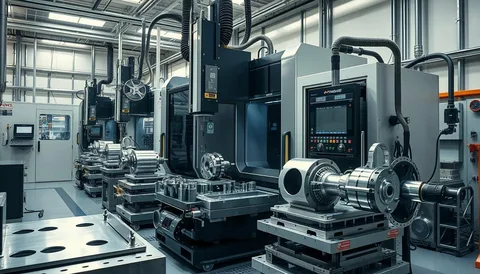
The aerospace industry demands extreme precision, durability, and reliability in every component used in aircraft and spacecraft. Even the smallest error in manufacturing can lead to serious performance or safety issues. This is where CNC (Computer Numerical Control) technology has become a game changer. Modern aerospace parts CNC machining manufacturing has revolutionized how components are designed, produced, and tested, offering unmatched accuracy and efficiency.
By using computer-controlled systems, manufacturers can produce highly complex geometries with tight tolerances that were previously impossible with traditional machining methods. As aerospace designs continue to evolve, CNC machining plays a critical role in meeting strict industry standards while improving production speed and consistency
Precision and Accuracy in Aerospace Manufacturing
One of the most significant contributions of CNC technology is its ability to deliver extremely high precision. In aerospace parts CNC machining manufacturing, components such as turbine blades, engine parts, and structural elements must meet microscopic tolerance levels. CNC machines follow programmed instructions with near-perfect accuracy, eliminating human error and ensuring each part is identical.
This precision is essential in aerospace applications where even a minor deviation can impact performance or safety. CNC machining allows manufacturers to produce complex parts repeatedly with consistent quality, making it a preferred solution for critical aerospace components.
The integration of advanced software and multi-axis CNC machines further enhances accuracy. Engineers can simulate and optimize designs before production begins, reducing the risk of defects and improving overall reliability in aerospace systems.
Use of Advanced Materials in Aerospace Parts
Aerospace engineering requires materials that can withstand extreme temperatures, pressure, and stress. CNC machining supports the use of advanced materials such as titanium, Inconel, aluminum alloys, and carbon composites. These materials are difficult to process using traditional methods but are efficiently handled through CNC systems.
In modern aerospace parts CNC machining manufacturing, cutting tools and machining strategies are specifically designed to work with these high-performance materials. This ensures structural integrity while maintaining precise dimensional accuracy.
Additionally, CNC machining allows manufacturers to experiment with lightweight yet strong materials, helping reduce aircraft weight and improve fuel efficiency. This balance of strength and weight is crucial for both commercial and defense aviation industries.
Increased Efficiency and Production Speed
Speed and efficiency are critical factors in aerospace manufacturing due to strict production deadlines and high demand. CNC machining significantly reduces production time by automating complex manufacturing processes. Once a design is programmed, machines can operate continuously with minimal human intervention.
In aerospace parts CNC machining manufacturing, multiple operations such as cutting, drilling, milling, and finishing can be performed in a single setup. This reduces the need for manual adjustments and shortens the production cycle.
As a result, aerospace companies can deliver parts faster without compromising quality. This improved efficiency not only supports large-scale production but also helps meet urgent demands in maintenance, repair, and overhaul (MRO) operations.
Automation and Digital Integration
Automation is a key driving force behind modern aerospace manufacturing. CNC machining systems are now integrated with CAD (Computer-Aided Design) and CAM (Computer-Aided Manufacturing) software, allowing seamless digital workflows from design to production.
In aerospace parts CNC machining manufacturing, this digital integration enables engineers to visualize, test, and refine parts before actual machining begins. This reduces errors and ensures optimal performance of the final product.
Automation also allows for real-time monitoring and quality control. Sensors and smart systems can detect issues during production, ensuring immediate corrections. This level of control enhances consistency and reliability across all aerospace components.
Cost Reduction and Scalability
While CNC machining involves advanced technology, it ultimately helps reduce overall production costs. By minimizing material waste, reducing labor requirements, and improving efficiency, manufacturers can achieve significant savings over time.
In aerospace parts CNC machining manufacturing, scalability is another major advantage. Whether producing a single prototype or mass-producing thousands of components affordable Dynamics 365 consultants, CNC systems can easily adjust to different production volumes without sacrificing quality.
This flexibility is especially valuable in the aerospace industry, where demand can fluctuate based on new aircraft models, military requirements, or maintenance needs. CNC machining ensures manufacturers remain cost-effective and competitive in a highly demanding market.
Conclusion
CNC machining has fundamentally transformed the aerospace industry by improving precision, efficiency, and material capabilities. Through advanced automation and digital integration, aerospace parts CNC machining manufacturing has become the backbone of modern aerospace production. It enables manufacturers to meet strict safety standards while maintaining high productivity and cost efficiency.
As aerospace technology continues to evolve, CNC machining will remain essential in developing next-generation aircraft and spacecraft. Its ability to deliver accurate, reliable, and scalable solutions ensures it will continue shaping the future of aerospace engineering for years to come.














Leave a Reply