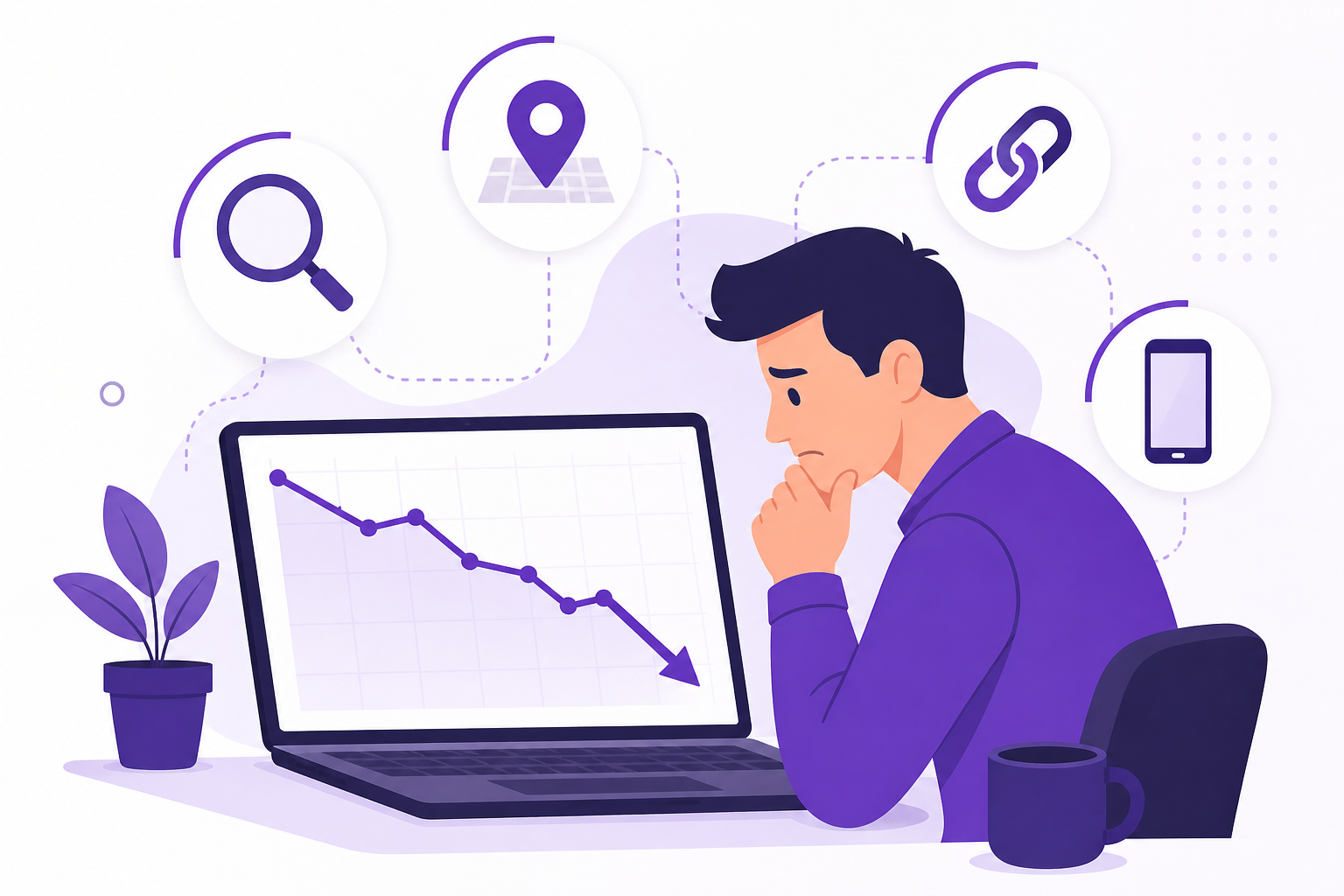
SEO Mistakes Killing Your Google Rankings in 2026
If you run a local business — whether you’re a dentist, contractor, healthcare provider, or ecommerce store — chances are you’ve invested time or money into SEO at some point. And yet, many businesses still struggle to show up where it matters most: the first page of Google.

As an SEO Expert, I’ve audited dozens of local business websites, and the same handful of mistakes keep showing up — regardless of industry or location.
The truth is, SEO isn’t just about keywords and backlinks anymore. In 2026, Google’s algorithms are smarter, more local-focused, and increasingly powered by AI-driven search experiences. That means old-school tactics that used to work can actually hurt you today.
Here are seven mistakes we see businesses make again and again — and what to do instead.
1. Ignoring Google Business Profile Optimization
For local businesses, your Google Business Profile (GBP) often matters more than your website content. Customers searching “plumber near me” or “dentist in [city]” are shown local results driven largely by your GBP — not your blog posts.
Fix: Keep your business hours, categories, photos, and services updated. Respond to every review, and add posts regularly to keep your profile active.
2. Targeting the Same Keyword on Multiple Pages
This is one of the most common — and most damaging — issues we find during SEO audits. When two or more pages on your website target the same keyword, they end up competing against each other instead of ranking well. This is called keyword cannibalization, and it confuses Google about which page to rank.
Fix: Assign each page a distinct keyword focus. If you have both a “Local SEO” page and an “SEO Services” page, make sure their content, titles, and meta descriptions are clearly differentiated.
3. Duplicate Meta Descriptions Across Pages
Duplicate meta descriptions are a quiet but serious technical SEO error. When multiple pages share the same description, Google can’t tell them apart — which weakens how each page is understood and ranked.
Fix: Write a unique, specific meta description for every page, ideally under 150–160 characters, that reflects exactly what that page offers.
4. Relying Only on Generic, Non-Local Content
Publishing generic content that could apply to any business, anywhere, rarely ranks well for local searches. Google increasingly favors content that reflects real local relevance — mentions of specific cities, neighborhoods, or region-specific concerns.
Fix: Build location-specific service pages that speak directly to a local audience, rather than one broad “Services” page trying to cover every location at once. Agencies offering SEO Services Across USA often build dedicated location pages for exactly this reason — it’s a proven way to strengthen local relevance city by city.
5. Chasing Backlink Quantity Over Quality
More backlinks isn’t always better. A handful of backlinks from relevant, trustworthy websites will do far more for your rankings than dozens of links from unrelated, low-quality, or spammy sites — and the latter can actually get you penalized.
Fix: Focus on 5–10 quality backlinks per page from sites relevant to your industry, rather than mass link-building from random directories. If you’re unsure where to start, working with a team that offers dedicated SEO Services USA can help you build a realistic, sustainable backlink strategy.
6. Neglecting Site Speed and Mobile Experience
Even great content won’t rank — or convert — if your site loads slowly or looks broken on mobile. Google’s Core Web Vitals directly factor into rankings, and a slow site frustrates real visitors before they even see your offer.
Fix: Regularly test your site speed and mobile responsiveness. Compress images, remove unnecessary scripts, and prioritize a clean, fast-loading design.
7. Not Adapting to AI-Driven Search
With Google’s AI Overviews and generative search features becoming more prominent, traditional tactics like FAQ schema markup for rich snippets have lost some of the visibility they once offered. SEO strategy needs to evolve alongside these changes rather than relying on outdated wins.
Fix: Stay informed on how search features are evolving, and focus on building genuine topical authority and trustworthy, well-structured content — the fundamentals that AI-driven search still values. Instead of chasing every algorithm update individually, build a content foundation strong enough to adapt: clear expertise signals, original insights, and pages that genuinely answer what your customers are searching for.
Bonus: Treating SEO as a One-Time Task
Many businesses still approach SEO like a website redesign — something you do once and move on from. In reality, search rankings shift constantly as competitors publish new content, Google updates its algorithms, and customer search behavior evolves. A page that ranked well six months ago can quietly slide down the results without any changes on your end, simply because the competitive landscape moved.
Fix: Treat SEO as an ongoing process, not a project with an end date. Regular audits, fresh content, and periodic technical checkups keep your visibility from slowly eroding.
The Bottom Line
SEO in 2026 isn’t about chasing shortcuts — it’s about consistency, technical accuracy, and genuinely local relevance. Businesses that get the fundamentals right — clean technical SEO, distinct page targeting, quality backlinks, and strong local signals — are the ones that build lasting visibility, not just quick wins that fade.
Frequently Asked Questions
1. How often should I update my SEO strategy? SEO isn’t a one-time task. Ideally, review your strategy every 3–6 months, and monitor rankings, traffic, and technical issues on an ongoing basis rather than waiting for a major drop to take action.
2. What is keyword cannibalization, and why does it hurt rankings? Keyword cannibalization happens when multiple pages on the same website target the same keyword. Instead of helping, this confuses Google about which page to rank, often causing both pages to perform worse than if only one page targeted that keyword.
3. How many backlinks does a website need to rank well? There’s no fixed number, but quality matters far more than quantity. A handful of relevant, trustworthy backlinks per page typically outperforms dozens of low-quality or unrelated links.
4. Does Google Business Profile really affect SEO rankings? Yes, especially for local businesses. GBP is one of the strongest ranking factors for local search results and Google Maps visibility, often mattering more than blog content for “near me” searches.
5. Is FAQ schema still useful with Google’s AI Overviews? Its impact has changed. While FAQ rich snippets appear less often now, well-structured FAQ content still helps search engines and AI systems understand your page’s context and relevance.
6. How long does it take to see SEO results? Most businesses start seeing meaningful movement in 3–6 months, though this varies based on competition, website history, and how consistently the strategy is executed.
7. Should every page on my website target a different keyword? Generally, yes. Assigning each page a distinct primary keyword avoids internal competition and helps Google clearly understand what each page is about.
8. Can duplicate meta descriptions actually hurt my SEO? Yes. Duplicate meta descriptions make it harder for Google to differentiate between pages, which can weaken how each page is indexed and displayed in search results.

This article was contributed by the team at MSEOExpert, a digital marketing agency specializing in SEO services for local businesses, healthcare providers, contractors, and ecommerce stores across the United States.